Adhesive Selection
Two pressure-sensitive adhesives, two very different ways to fail. The right choice depends far less on which tape feels stickier and far more on where, at what temperature, and for how long it has to hold.
A carton is sealed at two in the afternoon inside a 31°C warehouse and opened the next morning in a chilled distribution centre running at 4°C. The tape that looked flawless on the sealing line is lifting at both corners before anyone touches the box. Nothing about the tape changed between those two moments. The adhesive simply met a condition it was never selected for.
That is what the hot melt versus natural rubber comparison is really about. If your priority is low unit cost, high converting speed and stable performance over months of storage on smooth corrugated board, hot melt is usually the better answer. If you need aggressive initial grab, flexibility below 5°C and reliable wet-out on dusty, fibrous or slightly uneven surfaces, natural rubber is still hard to beat. Everything after that is formulation detail, and formulation detail is where most sourcing mistakes are actually made.
Both families are pressure-sensitive adhesives. They flow slightly under light pressure, wet out the surface they touch and build bond strength without any heat or solvent activation at the point of use. The similarity ends there.
A hot melt adhesive is a 100 percent solid system, typically built on EVA or on a synthetic rubber such as SIS or SBS, blended with tackifying resins, waxes and oils. It is melted at roughly 150°C to 180°C, applied as a hot film and allowed to cool into a permanently tacky layer. Because no carrier liquid has to be driven off, the coating line runs fast and the finished roll carries almost no solvent odour.
Natural rubber adhesive starts from cis-1,4-polyisoprene, the elastomer tapped from rubber trees, blended with tackifiers, plasticisers and antioxidants. It is normally applied from a solvent or water-based emulsion and then dried. The rubber chains stay long and mobile, which is exactly why the adhesive feels so aggressive the moment it touches a surface.
The two systems fail in opposite directions. Hot melt loses tack as it gets cold and creeps under shear when it gets hot. Natural rubber keeps working in the cold but ages in the dark: oxidation slowly hardens the rubber, the colour drifts toward yellow, and removal after a long service life can leave residue behind.
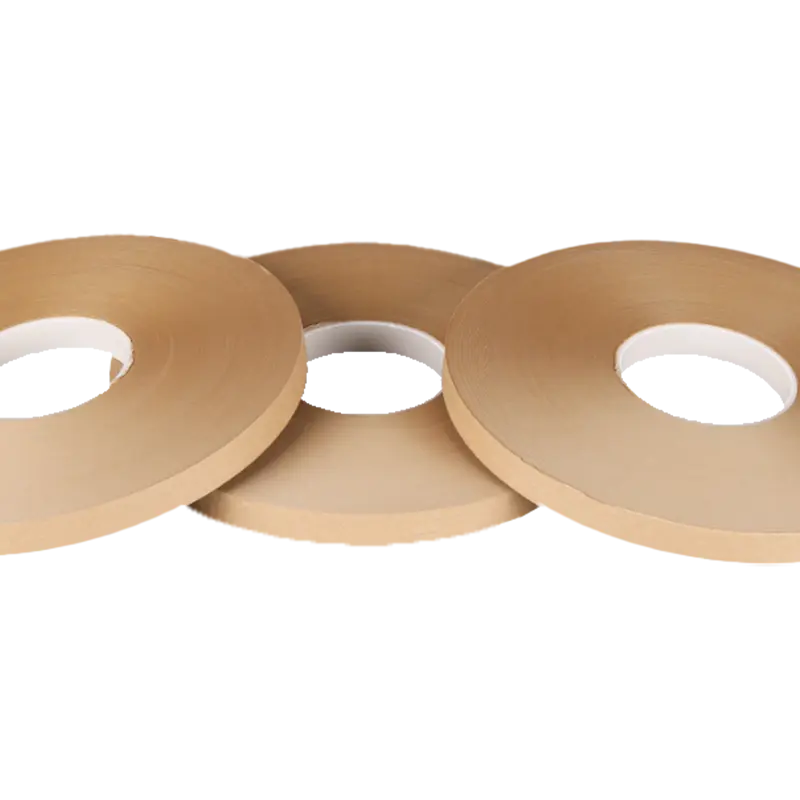
The coating method decides as much as the chemistry does. Hot melt is deposited by a slot die or roller at melt temperature and bonds to the backing as it cools, so the adhesive layer is dense and consistent. Natural rubber is coated as a liquid and dried in an oven or, in the case of cold-pressed kraft and cloth tapes, laminated under pressure at low temperature without melting the adhesive at all.
The cold-pressed route is worth understanding if you buy paper or cloth tapes. Because the adhesive is never taken to melting point, the rubber keeps more of its original molecular length, which is why a good cold-pressed tape grips so quickly on recycled board and fibrous surfaces.
There is a useful side note on terminology. Hot melt tape and pressure-sensitive tape are not opposites, and a short read on how hot melt tape differs from pressure-sensitive tape clears up a confusion that turns up in a surprising number of purchase specifications.
| Property | Hot melt | Natural rubber |
|---|---|---|
| Base chemistry | EVA or synthetic rubber plus tackifier, 100 percent solids | Natural rubber elastomer plus tackifier and antioxidant, solvent or emulsion applied |
| Initial tack | Moderate to high | High, with noticeably faster grab |
| Wet-out on rough or dusty surfaces | Limited | Strong |
| Low-temperature behaviour | Tack falls away below roughly 5°C | Stays flexible to around -20°C in many formulations |
| Long-term heat resistance | Roughly 50°C to 70°C | Roughly 50°C to 65°C |
| Ageing, UV and storage | Slow to discolour, stable for a year or more | Can yellow and embrittle over time |
| Peel build-up after application | Reaches a plateau quickly | Keeps climbing for hours |
| Solvent content and odour | Solvent-free, mild resin note | Solvent route may carry a trace odour |
| Relative unit cost | Lower | Higher |
| Typical formats | Carton sealing, general packaging | Cloth, masking, kraft and cold-pressed cowhide tapes |
For high-volume carton sealing, hot melt is the default for good reasons. It converts quickly, it costs less per square metre of adhesive, and it holds its properties through a year of warehouse storage far better than a rubber system will. On smooth corrugated board in a dry, temperate warehouse, a standard hot melt tape will often outlast the carton itself.
The limits are predictable. Adhesion to dusty, waxy or heavily recycled surfaces is weaker than with rubber. Performance drops quickly in the cold. And because the adhesive softens as temperature rises, long exposure above about 60°C invites shear creep, the slow sliding of the tape along the box seam that eventually opens a corner.
A container standing in direct sun on a dock can reach 60°C or higher inside. If your goods travel that way, a hot melt tape is already at the ceiling of its working range before the ship leaves port.
Cold chain logistics is the clearest case. A tape applied at 25°C and delivered into a freezer at -18°C has to stay flexible or it will crack and lift. Natural rubber formulations handle that transition, while a hot melt adhesive stiffens and loses its grip along the seam.
Rough surfaces are the second case. Recycled fibreboard, kraft paper, woven cloth and dusty metal all present a surface that a stiff adhesive cannot fully wet out. The softer rubber flows into the texture instead of sitting on top of it.
Third, there is the question of how much force is available at the moment of application. Hand-held dispensers and older sealing machines often apply low pressure. Rubber builds usable bond strength almost instantly, so it forgives a light hand in a way that hot melt does not.
Three variables decide most tape failures, and they interact rather than act alone.
Adhesive selection is not a question of which tape is stronger. It is a question of which one fails later under a specific set of storage, transport and surface conditions.
Solvent-based natural rubber tape usually costs more per roll than a comparable hot melt product, often by 20 to 40 percent. That gap is real, but it is not the whole calculation.
Two hidden numbers change the comparison. The first is usage: a tape with weaker initial tack often needs an extra wrap or a longer overlap to stay closed, and that consumes more metres per box. The second is rework. Every carton that arrives open costs far more than the tape difference on a thousand cartons once labour, reshipment and customer confidence are counted.
Purchasing teams that compare tape on price per roll alone frequently pay twice: once for the cheaper tape, and again for the rewrapping.
Adhesive data sheets are written for standard conditions, and your warehouse is not a standard condition. A short, structured trial answers the question faster than any amount of discussion.
A tape that survives both the cold box and the hot box will almost never let you down in an ordinary warehouse.
The shortlist below covers most industrial decisions without requiring a laboratory.
Supply matters as much as chemistry at this point. A tape that performs well in a trial but arrives with batch variation will cost you exactly the rework it was supposed to prevent. This is where an experienced converter helps: Wuxi Wanfeng Protective Film has been producing pressure-sensitive products since 1989 and operates six protective film lines and three tape lines, with annual output of more than 5,000 tonnes of PE protective film and 30 million square metres of tape, supplying manufacturers in the United States, Germany, Japan, Spain, Italy and more than a dozen other markets.
Choose the adhesive for the conditions your goods will actually meet, test it under those conditions, and confirm that the supplier can repeat the result batch after batch. Hot melt or natural rubber is a question of fit, not of quality.

Copyright © Wuxi Wanfeng Protective Film Co., Ltd. All Rights Reserved.
 English
 русский